The Real Cost of AI Isn't the Model. It's the Warehouse Underneath It.

Everyone's optimizing prompts and shopping for cheaper models. Meanwhile the bill is being run up by something nobody's watching: the thirty years of data sitting underneath the AI.
There's a well-worn playbook for saving money: buy in bulk, bundle services, go generic, buy last year's model, take the scratch-and-dent unit off the clearance rack. It's intuitive because it's about things, tangible, countable, easy to compare side by side.
Saving money on AI doesn't fit that playbook, and most companies try to force it anyway. They pick a cheaper model. They cap how many times a user can refine a prompt. They standardize projects so nobody goes rogue. None of that is wrong, exactly. It's just aimed at the wrong target.
If you actually want to control what AI costs your company, the real driver isn't the model you choose. It's the pile of data you point it at.
How we got a warehouse full of everything
Rewind to the 1990s. Big Data wasn't a buzzword yet; it was a decision. Large corporations, small companies, and plenty of individuals all made the same one: stop throwing anything away. Keep the emails. Keep the files. Keep the old copies, the superseded versions, the records nobody asked for in a decade.
That decision compounds quietly for thirty years. What was once 100 gigabytes crept to 500 gigabytes, then a terabyte, then beyond it. Today, it's worse, and it's still growing because purging was never part of the plan.
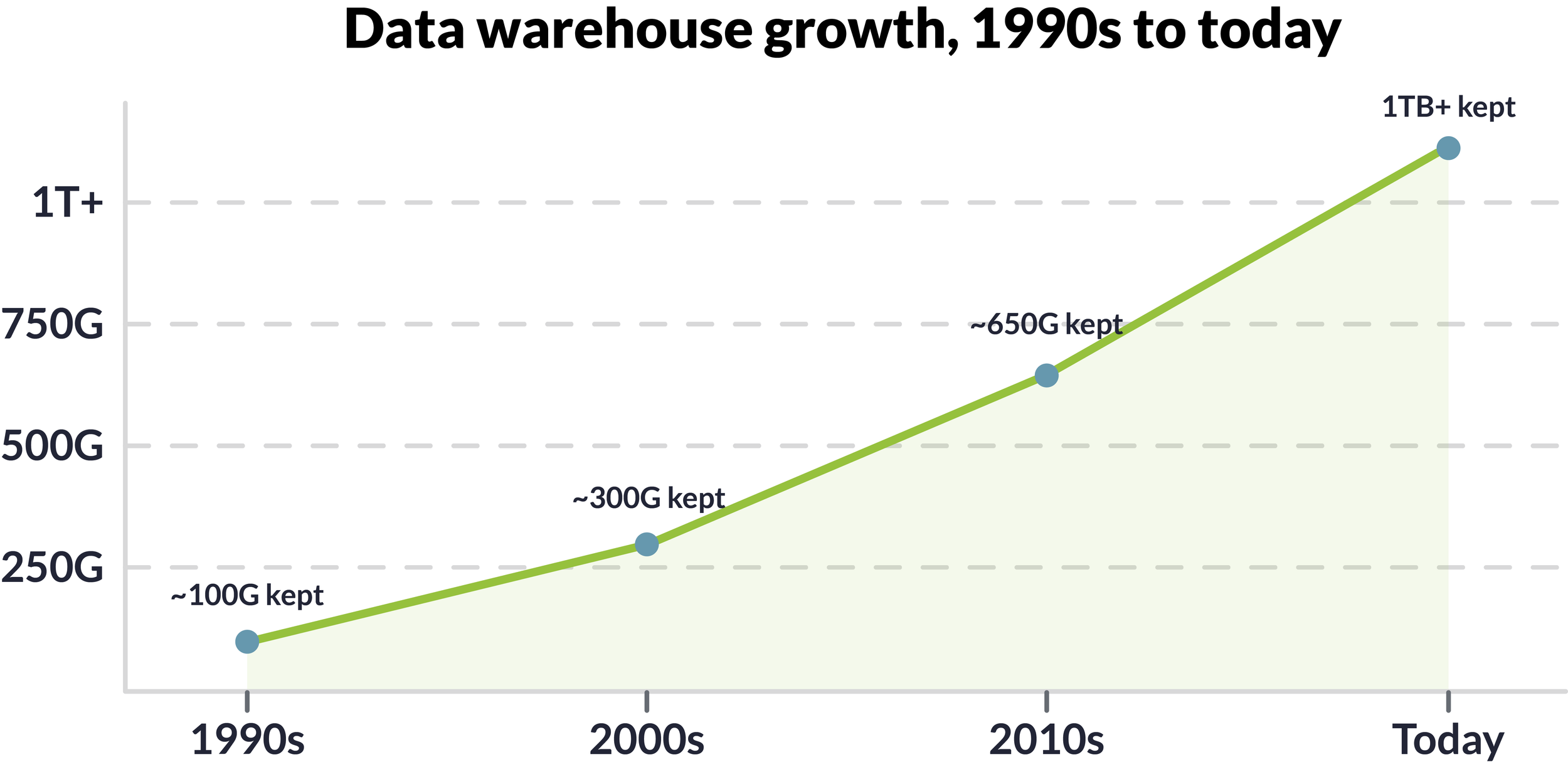
Illustrative trend: Most organizations' retained storage follows this shape once purging stops: nothing drops off, so the warehouse only grows.
Old data. Unused data. Duplicate copies of the same records stored in three different places because nobody wanted to say, “Delete it. We will never need it.” Add it all up and you get today's data warehouse, and it's measured in terabytes, not gigabytes.
Then AI gets pointed at all of it
Here's where the bill shows up. Putting AI on top of a full data warehouse is expensive, not because the model is expensive, but because the warehouse is enormous. Every token the model has to consider, every row it has to scan, every embedding that has to be computed costs compute time. Compute time costs money. Sitting an AI pipeline on top of the entire warehouse means paying full price on data that mostly isn't relevant to the question being asked.
This is the part the standard cost-saving playbook misses entirely. You can swap in a cheaper model. You can ration how many times someone refines a request. It won't matter much if the thing underneath is ten times bigger than it needs to be.
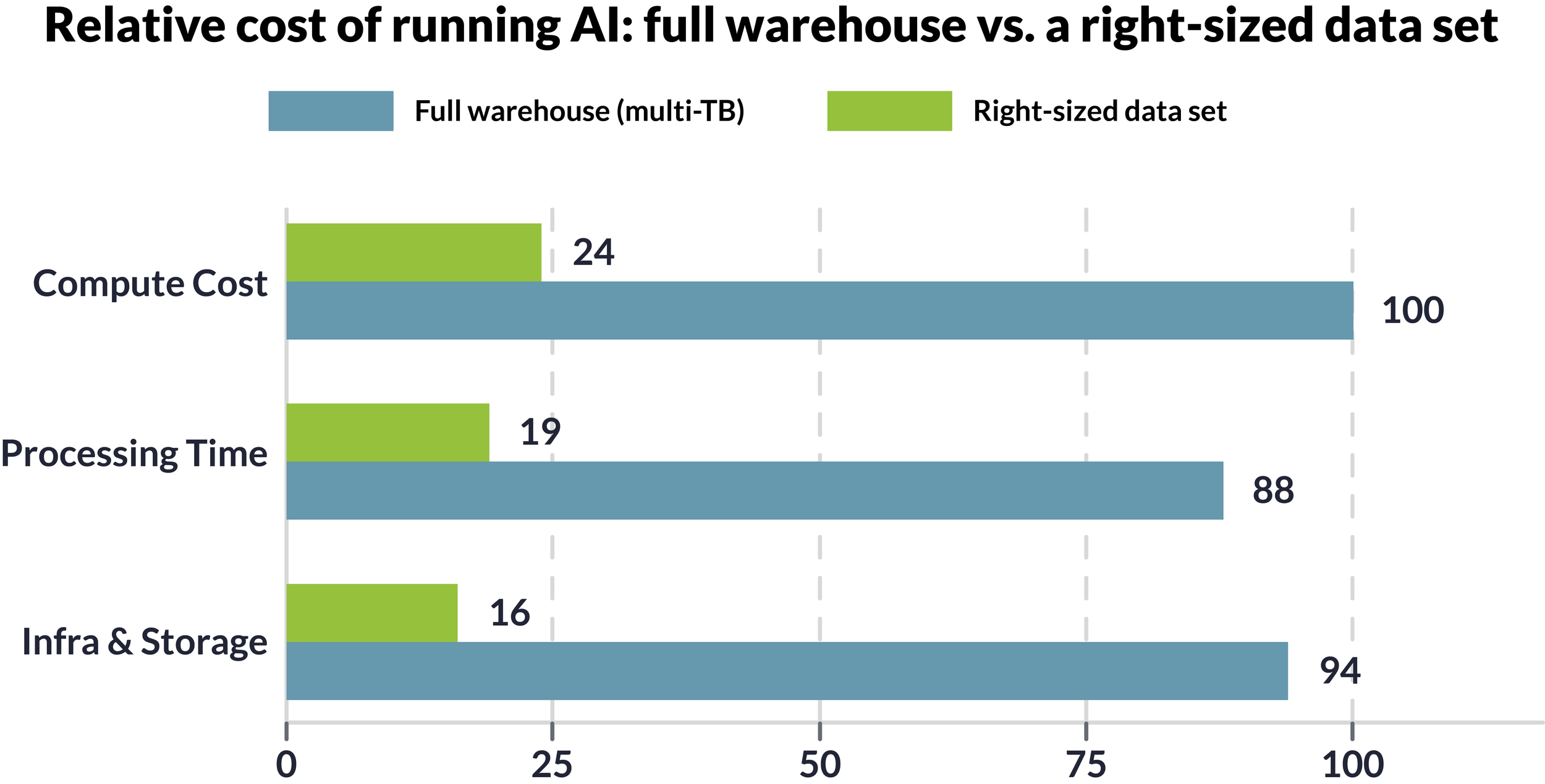
Illustrative model, indexed to 100 — the exact ratio depends on your warehouse, but the direction is consistent: scope the data down and every downstream cost drops with it.
The fix isn't a smaller AI model. It's a smaller, deliberately smaller, data set.
Limiting what AI is allowed to see reduces the compute time and power needed to complete the same task. Less data means less work done, which means a smaller bill at the end of the month.
Spend a little to save a lot
It's a cliché precisely because it's usually true: sometimes you have to spend money to save money. Properly scoping your data takes real expertise, and this is the part that's easy to underestimate. It isn't a setting you flip, it's a project.
It starts with finding the data that actually matters. That's a job for database administrators who know how to separate what a model needs from what simply got kept out of habit. From there, that right-sized set gets migrated into its own environment, on-prem, or in a cloud environment like Honeycomb so it's no longer tangled up with the rest of the warehouse.
Scoping it once isn't enough, either, because warehouses don't stop growing. Data engineers build the pipelines that keep that smaller set current as new data lands, and automate the purges that keep old, stale records from creeping back in and undoing the work.
Finally, AI engineers build and tune the AI solution against that curated set, tuned to produce accurate results quickly, because the data in front of them is the data that matters.
DBAs Find the data that's actually relevant and migrate it out of the warehouse
Models AI engineers train against the right-sized set for fast, accurate results
Pipelines Data engineers keep the smaller set current and automate purges, permanently
It takes experts across multiple fields working together, which is exactly why most companies solve this by changing their AI model instead of their data, even though that's the part that barely moves the number.
Fast, accurate, repeatable, and a lot less expensive
That's the combination worth building toward: a right-sized data set, kept current automatically, feeding a model trained to be accurate on exactly what you need it to know. Not a bigger budget for a smaller model. A smaller warehouse under the model you already have.
Honeycomb provides the cloud environment for that smaller, cleaner data set. Moser's DBAs and data engineers make sure it holds exactly what your company needs and nothing it doesn't. Moser’s AI engineers then build efficient, reliable models on that curated data, helping your organization get faster, more accurate results from the AI investments you already make.
Ready to Reduce the Hidden Cost of AI?
Before changing models or limiting usage, make sure the data underneath your AI is working for you, not driving unnecessary cost, risk, and complexity. Moser can help you identify the data that matters, create a right-sized and well-governed foundation, and build AI solutions that deliver faster, more reliable results.
Start a conversation with Moser about making your AI investment more efficient.